
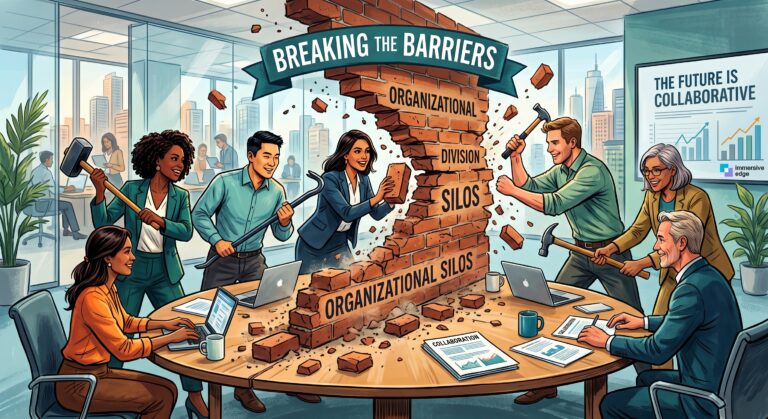
In June we ran a simulation for a fourteen-strong senior leadership team from a global services business. Same company, same goal, one room. Within twenty minutes they had rebuilt their own org chart inside it.
Marketing ran a live campaign that never reached the people selling, so sales worked blind to its own front end. Orders were authorised at one end of the table with no view, at the other end, of whether anyone could deliver them. Nobody withheld anything deliberately. It simply did not occur to busy people to volunteer what they held.
The instrumentation put a price on it. More than twice as much work taken on as could be delivered. Delivery running at 30% of capacity, with nearly half of all delivery weeks producing nothing. A $390,000 loss in the first round.
Here is the part that matters. Every person in that room could have told you, before the day started, that their organisation worked in silos. They had been told. They had nodded. Some of them had run the programme that told everyone else.
Understanding is not the hard part
The training industry has a favourite statistic about itself, that only 10% of training spend ever transfers to the job. It is worth knowing that the figure is not a measurement. It traces back through Baldwin and Ford’s 1988 review to a four-page commentary in a trade magazine, and when transfer has actually been measured it runs closer to two thirds immediately after training, falling to about a third a year later.
That is a worse finding than the myth, not a better one. Most training does land. It then drains away.
Baldwin and Ford’s real contribution was a definition, and it is the one sentence from the whole literature worth keeping: learning and retention are “necessary but not sufficient conditions” for behaviour change. A course can demonstrably teach someone something, measured by a test at the end of the day, and that tells you almost nothing about what they will do in six weeks. Blume and colleagues, pooling eighty-nine studies covering more than twelve thousand people, found that the strongest predictors of whether learning reached the job were not features of the training at all. They were supervisor support and the climate people went back to. For open-ended things like leadership and collaboration, the environment mattered several times more than it did for technical skills.
People do not fail to change because they misunderstood. They understood fine. They went back to a job organised exactly as it was before.
The number everyone quotes at the top of the change deck
Organisational change has its own favourite statistic, and it is in worse shape than ours.
“Seventy per cent of change programmes fail” comes from Hammer and Champy in 1993, where it is a range of 50 to 70%, is about reengineering rather than change in general, describes efforts that fell short of intended results rather than failures, and is described by the authors, in the same sentence, as “our unscientific estimate”. Hammer publicly disowned what had been done with it two years later. It was restated as fact without any citation in 2000, and later attributed by McKinsey to a 1995 Kotter article that contains no percentage anywhere in it.
Mark Hughes went looking for the evidence and published the result in the Journal of Change Management: “there is no valid and reliable empirical evidence to support such a narrative.”
We have quoted that 70% ourselves, and we were wrong to. The more interesting finding sits behind it. When Stouten, Rousseau and De Cremer reviewed the change literature for the Academy of Management Annals, they found that the popular staged models have, with one exception, “not been subject to direct empirical study, despite their popularity”. They also found that the most famous prescription of all, creating urgency before diagnosis, is not supported: urgency without diagnosis tends to produce fear, rigidity and avoidance rather than movement.
Which is a fair description of most change communications, and a large part of why traditional approaches to change management fall over.
What happened in round two
The same team over-committed again, the pattern they had been shown one round earlier, and this time the business went insolvent before the round could close.
Nobody blamed anybody. They asked to reset and run it again. That request is the moment the day exists to produce, because it forces a question that cannot be answered departmentally: why has this operation now failed twice?
The answers stopped being functional. Constraints started being surfaced before decisions rather than after. “Are we capable of delivering this?” replaced “can we win this work?” as the question that mattered. Late in the day one person said aloud that the team had nothing in production.
Round three, same people, same day. Delivery utilisation went from 30% to 72%. Ten of eleven orders completed, against five of nine. Service levels held above 90%. The opening round’s $390,000 loss became a $277,000 profit.
Nobody worked harder. Nobody was taught a new skill. What changed was what they could see about each other.
One point of honesty before anyone reaches for that as a result: this is evidence that a team learned quickly, not evidence that a business improved. We would rather draw that line ourselves than have you find it.
The debrief is where the change happens
If the research says one clearly practical thing, it is this, and it is not flattering to the simulation.
Tannenbaum and Cerasoli pooled forty-six studies and found that structured debriefs improve performance by roughly 20 to 25%, holding across individuals and teams and across both simulated and real settings. More pointedly, a three-arm trial published in Anesthesiology compared trainees who went through a simulated crisis with no debrief against those who were debriefed. The no-debrief group improved by minus one per cent. The authors’ conclusion was blunt: exposure to a simulated crisis without constructive debriefing “offers little benefit to trainees”.
A simulation without a serious debrief is a day out. We would say that to anyone considering buying one from us, and it is the first thing to interrogate when choosing a change management simulation.
What the debrief does is hand over the translation. In that June session the team did it unprompted. They named their own pattern the “yes syndrome”, a front end that keeps saying yes and a leadership team permanently firefighting. They described their real hand-offs as “chucking the baton over rather than handing it”. More than one person observed, pointedly, that it had taken a full day locked in a room for them to finally move through something together.
Nobody had to sell them any of that. There was nothing to argue with, because they had watched themselves do it.
That is not just a nice line. Kluger and DeNisi’s review of workplace feedback, pooling 607 separate measurements, found that feedback raised performance on average but that more than a third of feedback interventions made performance worse. What separated the two was where attention landed. Pointed at the task, it helped. Pointed at the person, people defended themselves and performance dropped. Which is a reasonable account of why appraisals change so little, and why a scoreboard that nobody is arguing with does something an opinion cannot.
The point
The pattern in that June session repeats across sectors. In a financial services leadership cohort, our facilitators recorded early rounds exposing roles acting independently with no visibility of other functions’ constraints. In an education group, delivery capacity was repeatedly exceeded because the people saying yes to work never checked with the people doing it. Different sectors, different seniority, same walls, and the ones that recover always recover the same way: constraints made visible across functions before decisions, not after.
You can tell a team all of that. They will nod, because it is obviously true, and nothing will happen.
Or they can spend a day building the walls themselves, going bust inside them, taking them down and banking the difference, and then explain the whole thing back to you in their own words before they leave the room. That is the difference between a simulation used as a catalyst for change and a workshop about change.
At which point the change is no longer yours to sell. It is theirs, and they will defend it in a meeting you are not in.