
Our transformative business simulations
One day. That's all it takes to change how your team sees itself, each other, and the business.
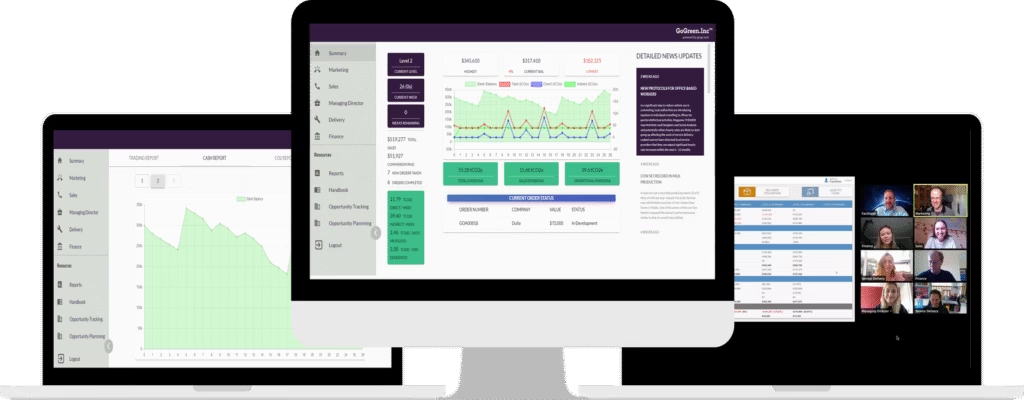
Our Simulations
Award-winning one-day business simulations that let teams see themselves, their colleagues and the business with fresh clarity.
TeamWork.Inc
- Collaboration
- Team Strategy
- Communication
Boardroom.Inc
- C-Suite Decisions
- Leadership
- Risk Management
GoGreen.Inc
- Sustainability
- ESG Strategy
- Financial Balance
Culture.Inc
- Cultural Change
- Employee Engagement
- Behaviour Dynamics
How it works
26 weeks of trade in 26 minutes, three or four times over
Teams take charge of a virtual company and have to deliver organisational success in a single immersive day. Groups of 5 to 15, divided into three or four rounds. After each round they stop, look at what their decisions caused, and go again.
What the day is actually like
Real pressure, no real consequences
The clock is the point. Under time pressure people stop performing the version of themselves they would present in a workshop and fall back on their defaults.
Results move while they decide
The team is not waiting for a verdict at the end. They watch the consequence arrive while they can still do something about it.
Then the debrief
Which is where people finally say the thing they have never said in a meeting, usually because they have just watched it happen.
How an engagement runs
Three phases, whichever simulation you choose
- 1
Needs analysis
- Needs analysis: an interview with the stakeholder to establish strategic priorities, the overall performance of the team, individual strengths and weaknesses, the alignment of the team with the strategy, and performance against the strategy.
- Key outcomes: to get the most value from the day, we identify and prioritise the objectives from three points of view: the organisation, the team and the individual, along with any specific challenge you want to address.
- Planning: the list of attendees and the set-up of the session, online or in a room.
- 2
Gameplay
Based on the needs analysis, the facilitation of the gameplay is adapted to the needs of the programme of work, and the innovations and ideas the team creates are captured. After each round, teams reflect to improve their performance in the next.
- 3
Real-world mapping
After the session, the facilitator works with the team to map what they learned onto their own workplace, and to turn it into specific actions for immediate implementation.
ReviewCapture innovations and learning.
MapApply innovations to real problems.
ActionSpecific, focused changes for immediate application.
What a single day is worth on its own
A one off engagement is not a consolation prize
A day does more inside a longer piece of work, and we will say so rather than pretend otherwise. But it is usually the fastest diagnostic a leadership team will get, and several clients buy it for exactly that.
Diagnostics
Where handovers fail, where information stops moving, which function actually gets listened to. In one afternoon rather than two quarters of noticing.
Insight you cannot schedule
Judgement shows under real pressure, and real pressure arrives on its own timetable. A day creates it deliberately, and safely.
A reset
A team stuck in the same argument gets a different one to have, and a shared reference to argue from afterwards.
Talent you would have missed
People who do not present well in a meeting often run a business rather well. A day is where that becomes visible.
Succession input
An objective behavioural data point on the people you are considering, sitting alongside appraisals and reputation rather than replacing them.
Benefits and applications
What organisations use the day for
Remote and in-person training
Classroom-based or fully online, on the same platform and with the same interface. Distributed teams get the same day as a group in one room.
Leadership development and team building
Not a day out. A team runs a business together and you get a read of how they actually work when the clock is going.
Commercial acumen and resilience
Orientating people to the fundamentals of running a business, in a safe space, before the decisions carry real money.
A specific challenge you already have
We will shape the day around what you are trying to find out, and tell you honestly if a simulation is the wrong instrument for it.
And many more
Our simulations and facilitation can be adapted to most business needs. These come up most often.
Leading and deciding
Leadership and management training · business strategy simulations · group decision making · cross silo leadership · managing conflict and resolution
Running and selling
Sustainability training · business process and operational simulations · customer service and soft skills · sales and negotiation · team building exercises
Customised simulations
If none of the five is quite the thing you are working on, we build the scenario around it. That is a real piece of work rather than a rebrand, so we will tell you honestly whether it is worth doing for your group size.
Common questions
Booking a simulation day: what people ask
How many people can take part?
5 to 15 per simulation, split into departments and roles. For larger groups we run several teams, each with its own facilitator, on the same day or across several days. One client put 12 online teams through Culture.Inc in three days.
How long does it take?
A day, usually about six hours from the start to the debrief. Teams play three or four rounds of 26 minutes, each covering 26 weeks of trade, with time to reflect after every round. Online programmes can also be split into shorter sessions a week or two apart.
Can it run online?
Yes. It runs in a room or fully online, on the same platform with the same interface. Distributed teams get the same day as a group sitting in one room.
Who runs the day?
Our facilitators, as standard. For leadership teams we can put two facilitators in the room, which allows closer observation. You can also run it through one of our delivery partners, or license it and have us train your own facilitators.
Do participants need any business or finance knowledge?
No. Our simulations have been played by school pupils as well as by boards.
Which simulation should we choose?
- TeamWork.Inc: collaboration across functions and silos, and change work.
- Boardroom.Inc: senior teams, leadership decisions, risk and governance.
- GoGreen.Inc: sustainability and ESG trade-offs.
Culture.Inc is a follow-up, for teams that have already played one of the other three. If none of them fits, we build a customised simulation around your sector and scenario.
Can it be tailored to our organisation?
Every engagement starts with a needs analysis: your strategic priorities, how the team performs now, any specific challenge you are facing at the moment, and what you want from the day for the organisation, the team and the individual. The facilitation and the debrief are built around the answers. If you need the business itself to look like yours, that is a customised simulation.
What happens after the day?
The facilitator works with the team to map what they learned onto their own workplace and turn it into specific actions: review, map, act. Every participant can receive a certificate of completion. If measuring change afterwards matters to you, we design that in with you before the day, not after it.
Is it just a team-building day?
No. A team runs a business together and watches the consequences of its own decisions arrive while it can still act on them. People enjoy it, but the point is what it shows about how the team actually works under pressure.
Is one day enough on its own?
Yes, for insight, discovery, learning and diagnostics. A single day accelerates all four far beyond what would happen naturally, and it is usually the fastest diagnostic a leadership team will get. Several clients buy it for exactly that.
For long-term change, we generally advise building the day into a wider programme, so the learning is reinforced and carried back into the organisation.
How do we book?
Tell us what you are trying to fix, and we will come back to you, usually within one working day, with how a simulation would approach it. Get in touch.
How it runs
Three ways to engage
Most clients start with us in the room and change that once they know what they are looking at.
We run it for you
We facilitate the day and work with your people beforehand to understand what you are trying to find out.
You get the session and our reading of what happened in it.
Best for
Team diagnostics, leadership away days, pilots before a wider rollout
A partner runs it with you
Several organisational development and leadership consultancies deliver our simulations inside their own programmes.
If the day is one step in something longer, a partner can build it into the programme and carry the work on afterwards. We will suggest one who fits.
Best for
Leadership programmes, change initiatives, blended development
Your own people run it
Once you have seen a day run and want it across the organisation, we train your facilitators over two days.
You get the simulation and the capability to run it. What you do not get is us in the room, so the debrief becomes yours to make.
Best for
Organisation‑wide rollout, repeat cohorts, in‑house academies
CONTACT US
Ready to transform your business?
Unleash human potential through serious games and experiential learning. Edge Experience, our award-winning family of one-day business simulations, transforms how your organisation works: insight discovered, not taught.