
Culture.Inc
Shape a positive, supportive culture for your business using the power of experiential learning to transform a failing business in the hospitality sector into a successful one that puts people at the heart of the organisation to drive success and productivity.

Culture simulation
Culture.Inc makes culture a thing the team has to trade against profit, not a value on a wall
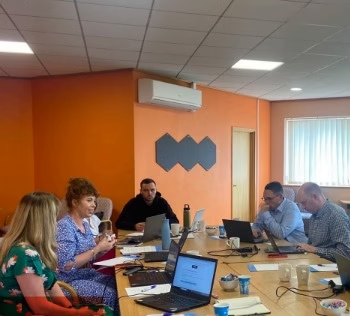
An experiential simulation and culture-focused workshop set in a failing hospitality business. Teams have to turn it round while building the kind of culture that keeps people in it, and the two pull against each other in every round.
Split into departments and roles, participants learn the aspects of company culture that actually get measured, including Net Promoter Score and employee NPS, by running the business rather than by discussing it. Played in a room or entirely online.
Why culture is hard to train
Everyone agrees with the values
Nobody argues against a good culture in a workshop. The interesting question is what people do when the quarter is going badly, and that only shows when something is at stake.
The trade off has to be real
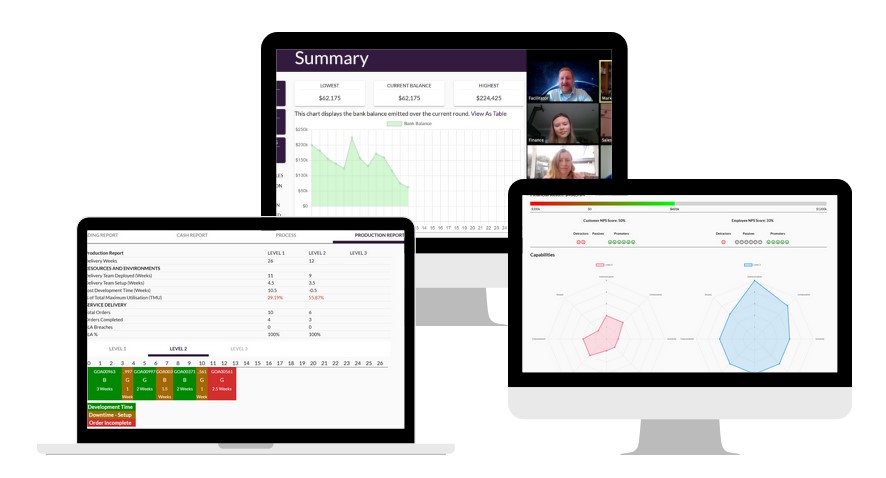
Here it is on the scoreboard. Teams see what a decision taken for the numbers costs them in staff and customer perception, in the same round.
What people said afterwards
Four clients on the Culture.Inc day
[Immersive Edge]’s simulations are fast, nerve-wracking and fun. In the Culture version of the game, we had to focus on developing a great company culture at the same time as generating profit. Not easy - would highly recommend!
This is a great tool and a very effective platform. On the surface it seems straightforward however it is a multi-faceted, deeply immersive, and powerfully accessible solution. The impact it has, and the opportunity it delivers for experiential learning, organisational positioning, and observational insight is staggering. Try it. Use it. Thank me later.
These 3 sessions of simulation were much more efficient than any team building exercise. We indeed learnt by doing, and it has enabled us to develop our network.
It is an excellent product: thought-provoking, fostering greater collaboration, process improvement and a better understanding of the big picture, and it’s FUN!
Benefits
What a group takes out of the day
Cultural awareness
Staff gain a deeper insight into what culture actually does in their working lives, rather than what it is supposed to mean.
Embedding company values
Teams work out quickly that the only way they can win is together, which puts culture in the middle of their decision making rather than alongside it.
Leadership and management
Inter-departmental trust is critical, and leaders find out whether they set the tone for it or merely describe it.
Group decision making with cultural weight
Decisions get made with the whole organisation in view, including what customers and staff will make of them.
Merger and integration
Participants from different company cultures come together behind the cultural mission of one organisation, which is a useful thing to rehearse before it has to be real.
Applications
Culture and leadership
Cultural awareness training · leadership and management training · group decision making · cross silo leadership · managing conflict and resolution
Teams and customers
Team building exercises · business strategy simulations · business process and operational simulations · customer service and soft skills · sales and negotiation
And many more. Our simulations and facilitation can be adapted to most business needs.

About Culture.Inc
There are three phases to a Culture.Inc implementation.
- 1
Needs analysis
- Needs analysis: an interview with the stakeholder to establish strategic priorities, the overall performance of the team, individual strengths and weaknesses, the alignment of the team with the strategy, and performance against the strategy.
- Key outcomes: to get the most value from the implementation, we identify and prioritise the objectives of the programme from three points of view: the organisation, the team and the individual.
- Planning: planning the implementation of Culture.Inc, the list of attendees, and the set-up of the session, virtual or in a classroom.
- 2
Delivery
Culture.Inc is delivered in three to four levels over up to one full day.
- Level 1: a culture-focused interactive workshop and overview presentation, so participants think about the productivity and agility of organisations through the lens of culture.
- Level 2: Culture.Inc simulation gameplay.
- Level 3: Culture.Inc simulation gameplay and an extended discussion to bring all the learning together.
- Level 4 (optional): an additional level of gameplay, subject to the timings and requirements agreed at the needs analysis stage.
- 3
Real-world mapping
After the session, the facilitator works with the team to take the captured learning and map it to their own workplace functions. As a final step, this is translated into specific actions for immediate implementation.
ReviewCapture innovations and learning.
MapApply innovations to real problems.
ActionSpecific, focused outcomes and learning that can be applied to real working environments after the session.
Teams are tasked with running and optimising a complete business in a few short hours. The business they are given is struggling, its processes are under-developed, and there is no rule book for improving it. The objective is to build a successful organisation that expands, has improved processes, and is profitable and agile in its marketplace.
A balanced scorecard
Teams are assessed on a balanced scorecard that answers four key questions.
“How do we look to our shareholders?” Financial performance.
“How do we continuously improve and create value?” Assessed by facilitators and teams on key capabilities relating to culture and performance.
“How do our customers see us?” A Net Promoter Score assessment of performance.
“What must we excel at?” An employee Net Promoter Score assessment of employee satisfaction and wellbeing.
We challenge teams to develop the strategies that deliver organisational success in a few short hours.
Each round is 26 minutes and covers the equivalent of 26 weeks of trade, which makes the gameplay fun and nerve-racking.
In our experience, players start out finding the simulation difficult and confusing, then improve round after round by coming up with their own ideas and systems to improve the business. Most, if not all, teams fail to succeed in round one, and they improve sharply as the rounds progress. The game lets teams try and fail in a safe environment.
Teams are split into departments and roles to play the simulation. The facilitator assigns a General Manager, and the team agrees how to allocate participants across the remaining roles.
- General manager
- Sales team
- Marketing department
- Hospitality department
- Finance department
Practice makes perfect
Experiential learning
Experiential learning is the most successful method of driving organisational change, improving thinking skills and creating lasting connections.
Based on David Kolb’s Experiential Learning Cycle, the recreation of real-world business scenarios lets people learn by doing, which brings higher engagement and emotional involvement.
Act, do, experience.
Look back and assess what went well, and what did not.
Make sense of the experience and draw conclusions.
Test your conclusions and develop a plan of action.
Certificates can be sent to all players, so they can demonstrate their learning and contribute to their personal and professional development.
Contact us about using your own brand on the certificates, next to ours.
Common questions
Questions about Culture.Inc
Can we start with Culture.Inc?
Not at the moment. Culture.Inc is a follow-up simulation, for teams that have already played TeamWork.Inc, Boardroom.Inc or GoGreen.Inc.
How do you measure culture in a simulation?
Teams are scored on a balanced scorecard: financial performance; maturity, assessed by the facilitators and the teams; Net Promoter Score, for how customers see the business; and employee Net Promoter Score, for staff satisfaction and wellbeing. A decision taken for the numbers shows its cost in staff and customer perception in the same round.
How is the day structured?
Three to four levels over up to one day. It opens with a culture-focused workshop, followed by two or three levels of gameplay and an extended discussion to bring the learning together.
Booking, group sizes, online delivery and what happens afterwards: see the common questions.
How it runs
Three ways to engage
Most clients start with us in the room and change that once they know what they are looking at.
We run it for you
We facilitate the day and work with your people beforehand to understand what you are trying to find out.
You get the session and our reading of what happened in it.
Best for
Team diagnostics, leadership away days, pilots before a wider rollout
A partner runs it with you
Several organisational development and leadership consultancies deliver our simulations inside their own programmes.
If the day is one step in something longer, a partner can build it into the programme and carry the work on afterwards. We will suggest one who fits.
Best for
Leadership programmes, change initiatives, blended development
Your own people run it
Once you have seen a day run and want it across the organisation, we train your facilitators over two days.
You get the simulation and the capability to run it. What you do not get is us in the room, so the debrief becomes yours to make.
Best for
Organisation‑wide rollout, repeat cohorts, in‑house academies
CONTACT US
Are you ready for a Culture simulation challenge?
Challenge your team(s) to improve and drive performance. The Culture.Inc business simulation training will transform your organisation through the power of experiential learning.