
Team building activities

Improving team dynamics and communication with business simulations.

Picture of a team bonding over team building activities to represent the power of serious games in team building exercises

Simulations for team building

A team building day where the team has to run a business together

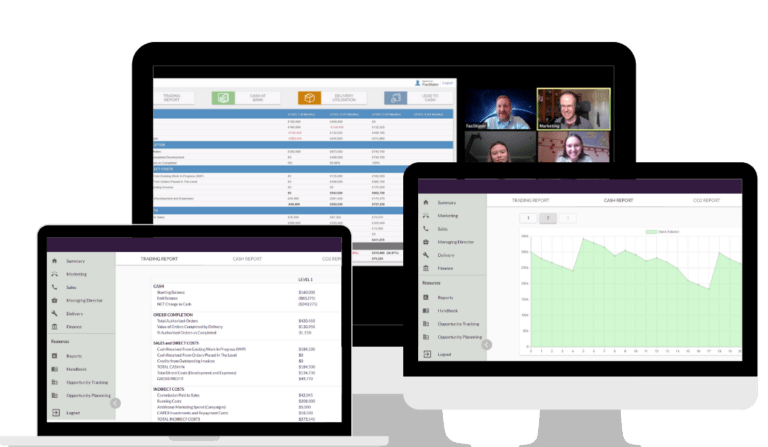
TeamWork.Inc recreates a working business using game technology and experiential learning. The simulation puts real commercial scenarios in front of a team and gives them no way to defer a decision, which is where the problem solving and the communication either happen or do not.

Played in a room or entirely online, participants run the business on a realistic, interactive platform. What they learn about each other comes from doing the work, not from discussing how they would like to work.

Built on ROCKET. Every Immersive Edge simulation runs on our own award winning platform: cost effective, scalable to a large group, and the same interface whether everyone is in one room or spread across a country.
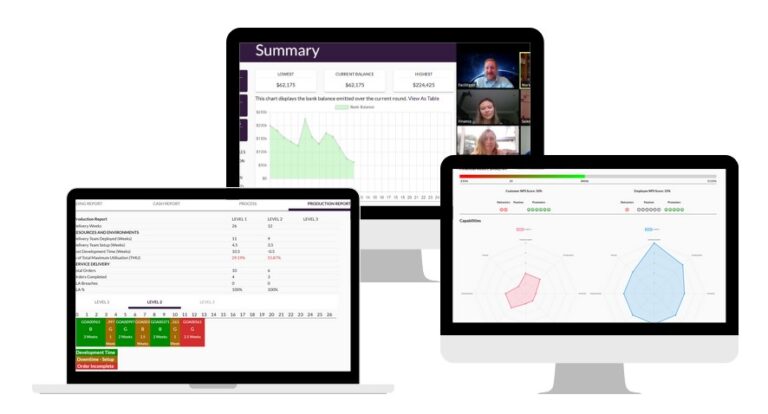
A team working through a round of the TeamWork.Inc simulation. The TeamWork.Inc simulation interface, showing the team dashboard.

Benefits

What a team takes out of the day

Not a list of topics covered. These are the things a team works out for itself once it is running a business and the clock is going.

01

Business empathy

Silo thinking has consequences, and the team meets them. People learn to see a problem coming from another function before it lands on theirs.

02

Team collaboration

Teams work out quickly that the only way to win is together, which is a harder thing to arrange in a workshop than it is in a simulation.

03

Building trust

Trust between functions decides most of the result. People feel the cost of holding information back rather than being told about it.

04

Systems thinking

Decisions get made with the whole organisation in view, because a good call in one function can still lose the round.

05

Common goals

Teams build the strategy the business needs, then watch it survive contact with the next round, or not.

This is a working day, not a day out. If what you want is an activity people enjoy and then forget, there are plenty of things that do that well, and we would not pretend to be one of them. What you get here is a team running a business together, and a read of how they actually work when the pressure is on.

Learning outcomes

TeamWork.Inc improves team dynamics, strengthens teams and builds trust

Business simulations are a practical way to upskill a workforce and keep it motivated, because the learning arrives as something the team did rather than something it was told.

How the team performs

  • Boosting productivity and cutting duplicated work and effort by pulling everyone onto a common goal
  • Tackling burnout by building stronger teams around people
  • Breaking silos and surfacing communication problems, by experiencing the tensions that emerge between roles
  • Improving leadership skills, and identifying both emerging leaders and training needs

How the team behaves

  • Building trust and psychological safety, so teams can operate with freedom, be open and take risks
  • Nurturing respect and developing loyalty in the workplace
  • Teaching business empathy by experiencing the typical roles in a business
  • Boosting creativity by pushing teams to use their own initiative rather than wait for direction

Experiential learning: practice makes perfect

Experiential learning is the most effective way to change how an organisation thinks, sharpen judgement and create connections that hold. Recreating real business scenarios lets people learn by doing, and the engagement and emotional involvement that come with that are the reason it sticks.

It is also why a team still refers back to what happened in round two months after the day itself.

26 weeks in 26 minutes

We challenge teams to find the strategy that delivers organisational success, in a few short hours.

The simulations are designed for groups of 5 to 15 people and divided into three to four rounds. Each round is 26 minutes and covers the equivalent of 26 weeks of trade. After each round, teams reflect and learn from what went wrong so the next one goes better.

How it runs

Three ways to engage

Most clients start with us in the room and change that once they know what they are looking at.

We run it for you

We facilitate the day and work with your people beforehand to understand what you are trying to find out.

You get the session and our reading of what happened in it.

Best for

Team diagnostics, leadership away days, pilots before a wider rollout

Talk to us

A partner runs it with you

Several organisational development and leadership consultancies deliver our simulations inside their own programmes.

If the day is one step in something longer, a partner can build it into the programme and carry the work on afterwards. We will suggest one who fits.

Best for

Leadership programmes, change initiatives, blended development

Ask who we would suggest

Your own people run it

Once you have seen a day run and want it across the organisation, we train your facilitators over two days.

You get the simulation and the capability to run it. What you do not get is us in the room, so the debrief becomes yours to make.

Best for

Organisation‑wide rollout, repeat cohorts, in‑house academies

Ask about facilitator training

CONTACT US

Ready to transform your business?

Unleash human potential through serious games and experiential learning. Our award-winning business simulations will transform your organisation.