
GoGreen.Inc
Become a sustainable business by connecting decision-making with the sustainability of your organisation in this engaging business simulation environment.

ESG and sustainability training
GoGreen.Inc makes the sustainability trade off a commercial decision, in front of the people who have to make it
An experiential simulation that connects everyday decision making with the sustainability of both an organisation and the planet. Split into departments and roles, teams have to turn a wasteful business with a negative CO2 impact into a sustainable one, while staying solvent and profitable.
Played in a room or entirely online, on a realistic and interactive platform. The tension is the design: every round asks the team to choose, and shows them what the choice cost on both scoreboards.
26 weeks of trade in 26 minutes
Teams are challenged to deliver organisational success in a few short hours. Groups of 5 to 15, divided into three or four rounds. Each round covers the equivalent of 26 weeks of trade, and after each one teams reflect on what went wrong before going again.
Benefits
Why organisations run it
Sustainability
Protecting the environment and the health of local communities, as an operating decision rather than a policy document.
Profitability
Saving on operational costs and mitigating against future energy use, which is where the commercial case for this usually lives.
Reputation
Aligning what the business does with what its customers say they value.
Resilience
Strengthening the business against greener legislation, and the penalties that come with missing it.
Investment
Opening up green investment and funding options that are closed to businesses without a credible position.
The detail
A short paper on the commercial and environmental case, if you need something to take into a meeting.
Learning outcomes
What people leave understanding
Across E, S and G
Environmental: sustainable sourcing, specific legislation and the targets that apply to a given organisation.
Social: welfare in the workplace, diversity and inclusion, community initiatives.
Governance: propagating and controlling innovation in best practice, inside the legislative environment.
The practical things
The difference between Scope 1, 2 and 3 emissions · where environmental, social and governance policy making actually diverge · communicating and sharing best practice to move ESG forward · embedding ESG thinking into decisions that are not obviously about ESG
About GoGreen.Inc
GoGreen.Inc asks teams to run a complete business in a few short hours. The business they are given is wasteful, with a negative CO2 impact, and the objective is to make it sustainable while keeping it solvent and profitable. Every round is scored on both.
How an engagement runs, from needs analysis to real-world mapping: see the three phases.
Teams are split into different departments and roles. Depending on their own job, participants may be asked to play a different role in the simulation.
- CEO
- Sales team
- Marketing department
- Delivery department
- Finance department
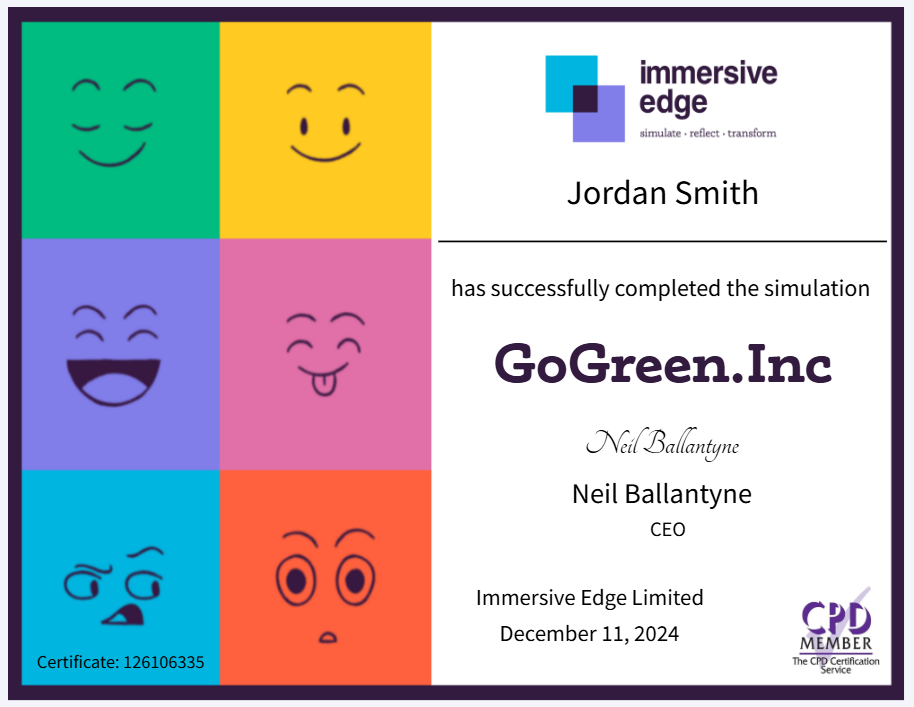
Certificates are sent to all players, so they can demonstrate their learning and contribute to their personal and professional development.
Common questions
Questions about GoGreen.Inc
How is sustainability scored?
On two scoreboards at once. Teams take over a wasteful business with a negative CO2 impact and have to make it sustainable while staying solvent and profitable. Every round shows what each choice cost on both.
Does it cover Scope 1, 2 and 3 emissions?
Yes. The difference between them is one of the practical learning outcomes, alongside how environmental, social and governance policy making differ.
Booking, group sizes, online delivery and what happens afterwards: see the common questions.
Sustainability in business
What is sustainability in business?
In a business environment, a sustainable organisation is one that is carbon neutral or climate positive. This means having a minimal or no negative impact on the environment, balancing any CO2 released into the atmosphere with an equivalent amount removed, or a positive impact, going beyond being a net-zero organisation by removing additional CO2 from the atmosphere. Ecosystem simulator games are an ideal tool to virtually simulate the challenges a business has to face when becoming more sustainable.
Why is sustainability important in business?
Sustainability fosters the longevity of an organisation by considering the environmental and social-economic effects of a business. Aside from protecting the environment, it strengthens business resilience by complying with greener legislation and avoiding penalties. Additionally, a company that recognises the need to act on sustainability, is capable to improve brand reputation by aligning with consumers’ values, attract green investment and funding options, and save on operational costs. Business simulations and games about the environment allow us to achieve green commitments and make a business more profitable.
How can sustainability reduce business costs?
Improving the environmental performance of a business maximises profitability. Good practices reduce business costs as they allow businesses to cut on energy, water, materials, packaging, and other resources. Although initial costs can be high, numerous case studies show significant savings in operational costs, whether by saving energy, reusing materials and resources, or optimising the efficiency of workspaces. Becoming green is a profitable long-term investment, and sustainable learning is key to do so.
What is the role of serious games in teaching sustainability?
Business simulation games allow educating users by showing them the impact that their actions can have. Serious games contribute to transforming workforces thanks to experiential learning techniques and the recreation of real-world business scenarios, allowing users to learn by doing and resulting in a higher player engagement and emotional involvement. With the need to become sustainable strengthening to comply with greener legislation and align with consumer values, eco games are an ideal tool to create sustainable-driven workforces.
What is ESG?
ESG is short for “Environmental, Social and Governance”. These three factors are a way to evaluate the sustainability and responsibility of a business. Many investors and brands consider these three categories to evaluate the potential profitability, risk, and opportunity of a business.
Within each ESG category, there are various related concerns. The “environmental” category includes sustainability concerns such as pollution, waste, and climate change. The “social” category takes into consideration the values and mission of a brand and its consideration of people, including gender and diversity inclusion, data protection, and customer satisfaction. “Governance” refers to the governance factors and logistics of decision-making, such as policymaking, board of directors, and hiring and onboarding practices.
How it runs
Three ways to engage
Most clients start with us in the room and change that once they know what they are looking at.
We run it for you
We facilitate the day and work with your people beforehand to understand what you are trying to find out.
You get the session and our reading of what happened in it.
Best for
Team diagnostics, leadership away days, pilots before a wider rollout
A partner runs it with you
Several organisational development and leadership consultancies deliver our simulations inside their own programmes.
If the day is one step in something longer, a partner can build it into the programme and carry the work on afterwards. We will suggest one who fits.
Best for
Leadership programmes, change initiatives, blended development
Your own people run it
Once you have seen a day run and want it across the organisation, we train your facilitators over two days.
You get the simulation and the capability to run it. What you do not get is us in the room, so the debrief becomes yours to make.
Best for
Organisation‑wide rollout, repeat cohorts, in‑house academies
CONTACT US
Become a green business
Contact us to find out how GoGreen.Inc can transform your organisation.