Boardroom.Inc
The ultimate business simulation for executive leadership training.

C-suite executive training
Boardroom.Inc hands a leadership team a business that is not working, and an afternoon to fix it
The hardest version of the simulation. Real commercial scenarios put pressure on leadership performance, succession, ambiguity, corporate risk and whole-of-system decision making, and nothing can be deferred to next quarter.
Participants have to build the governance around their improvements, make a profit, and leave behind an organisation agile enough to react when the market moves again. Unlike most executive training, they watch the consequence of a decision arrive while they can still do something about it. Failure is part of the design rather than a risk to be managed.
Why this one rather than a workshop
Meetings hide how a team decides
Most leadership teams agree in the room. The trouble starts afterwards, when the agreement turns out to have meant something slightly different to each person who nodded at it.
Defaults show under a clock
Who consults and who does not. Which function gets listened to. How much risk the team will carry when the quarter is going badly, which is rarely the number in the policy.
What people said afterwards
Four clients on the Boardroom.Inc day
This is probably one of the best training tools I have ever seen.
I watched the delegates learn invaluable lessons in business and teamwork. A fascinating day.
I gathered a number of insights into my team that I was able to action immediately. Highly recommended.
The team loved it and thought it was one of the best workshops we've ever been a part of.
Solutions and outcomes
Tackling C-suite challenges with executive training
Executive teams learn by doing rather than by being told what to do. What follows is what the day is set up to surface, not a promise about what happens afterwards.
Decisions and risk
Confidence in analysing and assimilating asymmetric, distributed data · a deeper understanding of complexity resolution · the unintended consequences of siloed decision making · weighing new technologies and innovations
The team itself
A healthier succession plan · business empathy from experiencing other viewpoints and how they interrelate · alignment of values behind one goal · management under stress, covering resilience, response times, delegation and escalation
The organisation
A culture of enterprise-wide digital transformation · adaptable, agile business models · anticipating fluidity in market conditions
The habit of stepping back
The single most common observation in a Boardroom.Inc debrief is how long it took the team to stop firefighting and look at the whole strategy.
About Boardroom.Inc
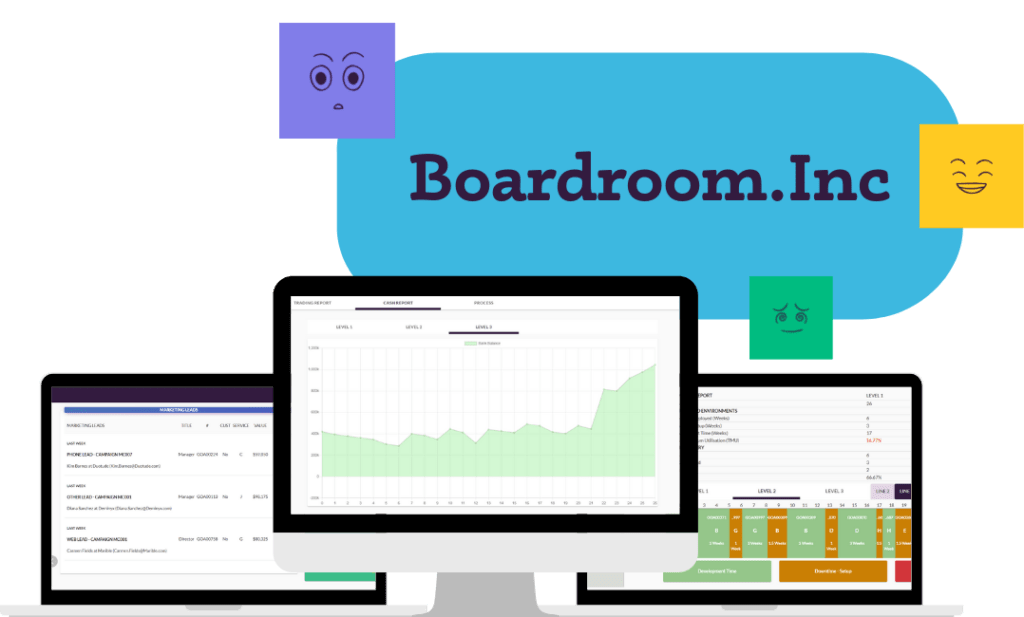
Boardroom.Inc asks teams to run and optimise a complete business in a few short hours. The business they are given is struggling, its processes are under-developed, and there is no rule book for improving it. The objective is to build a successful organisation that expands, has improved processes, and is profitable and agile in its marketplace.
How an engagement runs, from needs analysis to real-world mapping: see the three phases.
Teams are split into different departments and roles. Depending on their own job, participants may be asked to play a different role in the simulation.
- CEO
- Sales team
- Marketing department
- Delivery department
- Finance department

Certificates are sent to all players, so they can demonstrate their learning and contribute to their personal and professional development.
Common questions
Questions about Boardroom.Inc
Is it suitable for a real board or senior leadership team?
It is built for them. It is the hardest version of the simulation, with pressure on leadership decisions, governance, risk and succession, and nothing can be deferred to next quarter.
How is it different from TeamWork.Inc?
TeamWork.Inc is about how functions work together. Boardroom.Inc is about how a leadership team decides: who gets consulted, which function gets listened to, and how much risk the team will carry when the quarter is going badly.
Can it inform succession planning?
Yes, as one input. It gives you an objective, behavioural view of how people lead under pressure. It sits alongside appraisals and reputation rather than replacing them.
Booking, group sizes, online delivery and what happens afterwards: see the common questions.
How it runs
Three ways to engage
Most clients start with us in the room and change that once they know what they are looking at.
We run it for you
We facilitate the day and work with your people beforehand to understand what you are trying to find out.
You get the session and our reading of what happened in it.
Best for
Team diagnostics, leadership away days, pilots before a wider rollout
A partner runs it with you
Several organisational development and leadership consultancies deliver our simulations inside their own programmes.
If the day is one step in something longer, a partner can build it into the programme and carry the work on afterwards. We will suggest one who fits.
Best for
Leadership programmes, change initiatives, blended development
Your own people run it
Once you have seen a day run and want it across the organisation, we train your facilitators over two days.
You get the simulation and the capability to run it. What you do not get is us in the room, so the debrief becomes yours to make.
Best for
Organisation‑wide rollout, repeat cohorts, in‑house academies
CONTACT US
Ready for a C-Suite assessment?
Challenge your C-Suite to improve and drive performance. Boardroom.Inc C-Suite executive training simulation will transform your organisation.