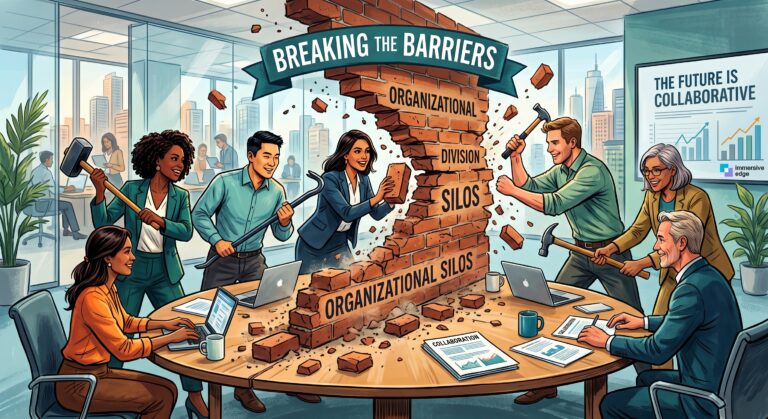

Organisational silos are what happens when departments stop sharing information, decisions and goals with each other. Not because people are difficult, but because the structure around them quietly rewards it. They form through specialisation, distance and local targets; they persist because most fixes (new tools, reorgs, away days) never change what teams actually feel responsible for. At Immersive Edge we watch teams form and break silos every week inside our one-day business simulations, and this piece sets out what we’ve learned: why silos happen to good people, why the standard remedies disappoint, and the three conditions under which they genuinely break.
You don’t have a communication problem
You already know the symptoms. Two departments discover, late and usually expensively, that they’ve been solving the same problem in parallel. Meetings between functions feel less like collaboration and more like diplomacy. Decisions that make perfect sense inside one team land as costs on another. Everyone agrees “we need to communicate better,” a new channel or tool appears, and six months later nothing has changed except the number of unread messages.
The scale of this is measurable. In Gartner’s 2024 research, 84% of leaders and employees reported experiencing high “collaboration drag” when working across functions: too many meetings, too much feedback, no clear decision authority. Organisations suffering it were 37% less likely to hit their revenue goals, and employees experiencing it were fifteen times more likely to report burnout. The same research team, writing in Harvard Business Review, found a typical large organisation running up to five major initiatives at once, each spanning five to eight functions and 20–35 people. The walls between teams aren’t a soft-skills nuisance; they are a measurable drag on performance and a measurable driver of attrition.
Here’s the uncomfortable part: almost none of this is caused by poor communication skills. Silos are not primarily a communication problem. They are a structure and consequence problem that shows up as communication symptoms, which is why communication-first fixes so rarely work.
What organisational silos actually are (and what they aren’t)
An organisational silo is a part of a business (a department, a function, a site, sometimes a single team) that operates with its own information, priorities and habits, largely disconnected from the parts it depends on. “Silo mentality” or “silo thinking” is the mindset that grows inside those walls: our targets, our budget, our way of doing things, with other departments cast as obstacles, internal customers to be managed, or simply strangers.
It’s worth being precise about what silos are not, because the distinction changes the cure. Specialisation is not a silo. You want finance to think like finance and engineering to think like engineering; deep expertise is the whole point of having departments. A silo is what forms when the information and the incentives stop crossing the boundary, and expertise turns into enclosure. As Patrick Lencioni argues in Silos, Politics and Turf Wars, silos are rarely created by the people inside them; they’re an unintended product of how leaders set up goals, rewards and rivalries above them.
Why silos form, even in companies full of good people
Nobody arrives at work intending to hoard information. Silos assemble themselves from five ordinary forces, usually in this order.
Local targets do most of the damage. The moment each department has its own KPIs, and is praised, budgeted and promoted on them, every rational person optimises locally. If the warehouse is measured on cost per unit and sales on revenue, a decision that helps one and hurts the other isn’t a moral failure; it’s each team doing exactly what it was asked to do. The silo is the sum of everyone hitting their numbers.
Distance hardens it. Different floors, different sites, different time zones, and now different hybrid schedules. When you never bump into the people downstream of your decisions, they become an email address rather than a colleague. Remote and hybrid work didn’t invent silos, but it removed most of the accidental collisions that used to soften them.
Leadership models it. Teams watch how their leaders treat other departments and copy it with remarkable fidelity. If the executive team operates as a collection of departmental ambassadors negotiating on behalf of their functions, rather than as one team running one business, the silo pattern replicates all the way down. This is Lencioni’s central point, and it matches what we see: silo behaviour is learned from above far more often than it’s invented below.
Identity seals it. Humans bond with the group they share deadlines and in-jokes with. “We” and “they” language creeps in, then explains everything: they always change requirements, we always get blamed. In-group loyalty is a feature of human teams; it becomes a bug only when the organisation gives it walls to attach to.
Success finishes the job. The counterintuitive one: high-performing departments grow the thickest walls. A team that’s winning has the least incentive to change how it works and the most confidence that outsiders would only slow it down. Some of the most siloed organisations we meet are successful ones: the silo is protecting something that works, at the expense of the whole.
Notice that not one of these five is fixed by asking people to communicate more.
Why the usual fixes disappoint
Most silo advice, and most of what ranks when you search for it, is a list: adopt a collaboration tool, restructure, run a team-building day, get leadership to “set a shared vision.” Each of these fails in a specific, predictable way, and it’s worth naming the mechanism, because it points at what actually works.
New tools move the silo; they don’t melt it. Slack, Teams and shared dashboards make information available across walls, but silos were never mainly an availability problem. Forrester finds 82% of organisations still describe cross-department data sharing as a challenge, and MuleSoft’s 2025 Connectivity Benchmark counts an average of 897 applications per organisation with under a third integrated. More channels without changed incentives simply produces collaboration drag with better software.
Reorgs redraw the walls; behaviour rebuilds them. Restructuring changes who sits inside which boundary. It doesn’t change the habit of optimising locally, so within a few quarters the new structure has grown new walls, plus the scar tissue of the reorg itself.
Away days generate goodwill without consequence. People genuinely like each other more after a day of shared activity, and then return to the same targets, the same hand-offs and the same incentives. Warmth without interdependence decays in weeks. (We’ve written more about why this happens in team building that actually changes behaviour.)
Exhortation asks people to act against their incentives. “One team, one dream” posters lose to the performance review every single time. If the org chart pays for local optimisation, a values statement will not outbid it.
The common thread: all four try to change how people talk across the walls. None changes what people feel responsible for, and that’s where silos actually live.
What actually breaks silos: consequence you can feel
Strip away the tactics, and every silo we have ever watched break, in client organisations and inside our simulations, broke under the same three conditions.
First, a shared outcome that nobody can reach alone. Not a slogan: a number, a deadline, a customer, a P&L that belongs to everyone in the room. The outcome has to be structured so that one department winning while another loses reads, unmistakably, as everyone losing.
Second, cause and effect made visible across the walls. People change when they see their decision land somewhere else: when the discount sales offered shows up as the margin finance can’t recover, when the corner one team cut becomes the fire another team fights. In normal operations this feedback loop takes months and arrives buried in a report, sanitised of any feeling. The lesson never lands, so the behaviour never moves.
Third, it has to be safe to get it wrong. Nobody experiments with cross-boundary trust when a real budget, a real customer or a real career is on the line. Psychological safety isn’t a nice-to-have here; it’s the precondition for anyone dropping a defensive habit long enough to try a collaborative one.
Real organisations struggle to produce all three at once, and it’s no mystery why: live operations have slow feedback, high stakes and genuinely competing targets. This is exactly the gap a business simulation exists to close: it manufactures those three conditions deliberately, then lets a team experience them in a single day.
What we see in the room when silos break
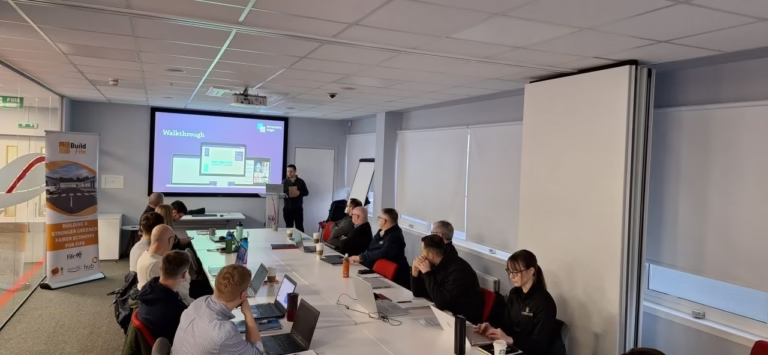
In TeamWork.Inc, our flagship team simulation, a team takes over a struggling virtual company, split into functional roles spanning leadership, marketing, sales, delivery and finance, and runs it through successive trading periods compressed into minutes, three rounds in a day. The company’s design makes one thing true and non-negotiable: the only way to win is together. The simulation instruments everything, so what follows isn’t impression; it’s measured. Here is one recent session, a fourteen-strong senior leadership team from a global services business, run by two of our facilitators with one dedicated purely to structured observation.
Round one: the room recreated the org chart. Given one company and one shared goal, the team still began the day as five functions rather than one business. Marketing ran a live campaign that never got communicated to sales, so sales worked blind to its own front end: a handover missed rather than made. Orders were authorised at one end of the table with no shared view, at the other end, of whether there was capacity to deliver them; work stalled in the space between functions rather than moving through it. Nobody was hoarding out of malice; it simply never occurred to busy people to volunteer what they held. The numbers put a price on the walls: the team took on more than twice the work it could deliver, ran its delivery operation at 30% of capacity while nearly half its delivery-weeks produced nothing, and closed the round roughly $390,000 down in simulation currency.
Round two: the walls got expensive enough to feel. The team over-committed again (the same pattern, flagged the round before) and this time the business went insolvent before the round could close. What happened next is the part worth studying. The room did not turn to blame; frustration was voiced, but the tone stayed closer to rebuilding than fault-finding. Rather than accept the result, the team chose to reset and run the round again. That decision was the turning point, because it forced the question the day exists to surface: why has this operation failed twice? The answers stopped being departmental. Constraints got surfaced before decisions instead of after. “Are we capable of delivering this?” replaced “can we win this work?” as the question that mattered. Late in the day came the plainest moment of all: one member said aloud that the team had nothing in production. Insight that’s discovered, not taught, is insight that sticks.
Round three: the same people, without the walls. Delivery utilisation climbed from 30% to 72%. The team completed ten of eleven orders instead of five of nine, held its service levels above 90% throughout, and turned the opening round’s $390,000 loss into a $277,000 profit. Not by working harder; by changing how it worked together. In the debrief, the participants did the transfer work themselves, unprompted: they named the pattern the “yes syndrome” and mapped it straight onto their real organisation: a front end that keeps saying yes, a leadership team left permanently firefighting. They described their own real-world hand-offs as “chucking the baton over rather than handing it.” (We’ve written more about that pattern in pass the baton, don’t throw it: what relay teams know about hand-offs.) And more than one observed, pointedly, that it had taken a full day locked in a room for the team to finally move through something together, and that the simulation had accurately reflected how they behave when they start.
And this isn’t one team’s story. The same opening pattern shows up wherever we run the simulation: in a financial-services leadership cohort, facilitators recorded that early rounds “exposed siloed thinking; roles acted independently with limited visibility of the constraints faced by other functions”; in an education group, delivery capacity was repeatedly exceeded for the simple reason that the people saying yes to work never checked with the people doing it. Different sectors, different seniority, same walls. And the groups that recover always recover the same way: constraints made visible across functions before decisions, not after.
A team can be told it works in silos and nod along; this team watched itself build the walls, went bust inside them, took them down and banked the difference, all before dinner. That felt reference is what survives contact with the following Monday. The results in our case studies show how it plays out over the months after.
Five things to do on Monday
A simulation compresses the lesson, but the conditions it teaches can be built into ordinary operations. If you change nothing else, start here:
Give feuding functions one number they share. Pick the two departments with the worst boundary and make one outcome (margin on a product line, time-to-resolution, a launch date) count identically for both. Shared consequence is the seed of everything else.
Make the hand-off costs visible. Most silo damage happens at hand-offs and is invisible to the team that caused it. Trace one workflow end-to-end with everyone who touches it in the room, and put numbers on the rework and waiting time. The reaction is usually genuine surprise, which is the point.
Trade people, briefly. Short rotations and shadowing, even a fortnight, convert “they” into a person with a face and constraints. It is much harder to silo against someone whose Tuesday you’ve seen.
Fix the executive team first. If your leadership meeting is a gathering of departmental ambassadors, every fix below it will be cosmetic. Leaders publicly making a decision that costs their own function for the good of the whole gives everyone else permission to do the same. (This is where much of our executive simulation work focuses.)
Let the team rehearse interdependence somewhere safe. Habits formed over years rarely dissolve mid-quarter with live stakes. Give people one day in an environment where the walls demonstrably cause failure, mistakes are free, and the win is only reachable together, then debrief it against the real org. That rehearsal is exactly what TeamWork.Inc was built for.
Frequently asked questions
What does “working in silos” actually mean?
It means teams or departments operating in isolation: holding their own information, chasing their own targets and making decisions without reference to the people who depend on them. The phrase describes a pattern of behaviour, not a formal structure: an organisation can have a perfectly sensible org chart and still work in silos every day.
What causes silo mentality in the first place?
Five ordinary forces: department-level targets that reward local optimisation, physical or hybrid distance, leaders who model departmental rivalry, natural in-group identity and, counterintuitively, success, since winning teams have the least reason to open their walls. It is almost never caused by individuals being uncooperative by nature.
Are silos ever a good thing?
The specialisation inside them is. Deep functional expertise, clear ownership and focused teams are strengths worth protecting. Silos become damaging at the boundaries, when information, decisions and goals stop crossing between functions. The aim isn’t to abolish departments; it’s to make the walls porous.
How do you break down silos between departments?
Change what teams share, not just how they talk: one outcome both departments own, fast visible feedback on cross-boundary decisions, leaders who model whole-business thinking, and a safe setting to practise the new pattern. Tools and reorgs support this but cannot substitute for it; see the five Monday actions above.
Has remote and hybrid work made silos worse?
It has removed most accidental cross-team contact (corridor conversations, overheard problems, shared lunches) which used to soften boundaries for free. Distributed teams need deliberately engineered collisions: shared rituals, rotations and periodic in-person experiences that rebuild cross-functional trust on purpose. It’s one of the most common reasons teams come to us; our simulations run virtually as well as in the room partly for this reason.
How quickly can a team actually change?
Faster than most change programmes assume, if the insight is experienced rather than presented. One day is enough for a team to see its own silo pattern and feel what replacing it does to results; the weeks after are about reinforcing that pattern against old incentives. (Most change efforts fail on exactly that follow-through; we’ve written about why change programmes fail and what works instead.)
Immersive Edge runs one-day business simulations, used for diagnostics, training and change management, that let teams see themselves, their colleagues and the business with fresh clarity. If silo working is costing your organisation more than it should, talk to us or explore the case studies.