
Organisational change is slow for a reason: the consequences of how people work arrive months after the behaviour that caused them, buried in reports, stripped of any feeling. A business simulation is a catalyst in the proper sense of the word. It doesn’t add force to your change programme; it lowers the energy the reaction needs, by letting a team experience the consequences of its habits, and the payoff of changing them, inside a single day. At Immersive Edge we run one-day simulations that do exactly this for diagnostics, training and change management. But acceleration is only half the story: when people work out the solutions themselves, the change stops being something imposed on them and becomes something they own. Here is how that works, and the evidence behind it.
Why change is slow by default
Most change programmes are built from explanation: the case for change is presented, the new behaviours are described, workshops are attended, posters go up. People nod. And then Monday happens, because nothing in the explanation ever touched the loop that actually governs behaviour: act, feel the consequence, adjust. In normal operations that loop takes a quarter or more to complete, and by the time the consequence lands, it’s abstract, delayed, and easy to attribute to someone else.
That’s why change fails on human behaviour far more often than on strategy. (We’ve written separately about why change programmes fail, and the honest answer is rarely that the plan was wrong.) People aren’t resisting the change so much as continuing to respond to the consequences they can actually feel, which are the old ones. Until the new way of working produces a felt result, the old way keeps winning by default.
What a catalyst actually does
In chemistry, a catalyst doesn’t change what the reaction produces; it dramatically lowers the energy required to get it started. That is precisely the role a simulation plays in a change programme. The destination stays yours: the strategy, the restructure, the new operating model. What the simulation changes is the cost of the first step, in three ways.
It compresses the feedback loop from months to minutes. In a simulation, a team runs a business through successive trading periods in a single day. A decision made before coffee has visible, measurable consequences by mid-morning. The act-consequence-adjust loop that takes a quarter in real life completes several times before the debrief, which means a team can fail, diagnose, and correct inside one day, an arc that live operations would spread across a year.
It makes the case for change felt, not argued. People defend themselves against arguments; they rarely defend themselves against their own experience. When a team watches its own habits produce a measurable result, nobody has to be persuaded of the diagnosis, because the team made it itself. Insight that’s discovered, not taught, is insight that sticks, and it engages both logic and emotion, which is where lasting behaviour change actually lives. Just as importantly, the diagnosis belongs to the team: a conclusion people reach themselves needs no selling afterwards.
It removes the risk that keeps everyone frozen. Nobody experiments with new behaviour when a real budget, customer or career is on the line. In a simulation, mistakes cost nothing but teach everything, so people try the unfamiliar thing years before they otherwise would.
The evidence that experience outperforms explanation
This isn’t just our observation; the research base is consistent.
The largest meta-analysis of simulation-based training, covering 65 studies and more than 6,000 trainees (Sitzmann, 2011, Personnel Psychology), found that people trained through simulation games came out with around 20% higher self-efficacy, 11% more declarative knowledge, 14% more procedural knowledge and 9% better retention than comparison groups taught conventionally. Self-efficacy and retention are the two numbers that matter most for change: believing you can operate the new way, and still knowing how months later.
On the organisational side, research published in the Journal of Public Health Management and Practice (Jones et al., 2024) found that 95% of employees surveyed wanted to reduce silo working, and identified four conditions that make collaboration take hold: inclusion, shared goals and vision, bi-directional communication, and relationship building with trust. Read that list against a well-designed simulation and you’ll notice something: those four conditions are not outcomes a simulation hopes for. They are the operating rules of the day. Everyone plays, the goal is explicitly shared, information must move in both directions for the team to survive, and trust gets built the only way it reliably does, through shared consequence. A simulation is those research-backed conditions, manufactured deliberately and experienced in a day.
What acceleration looks like in the room
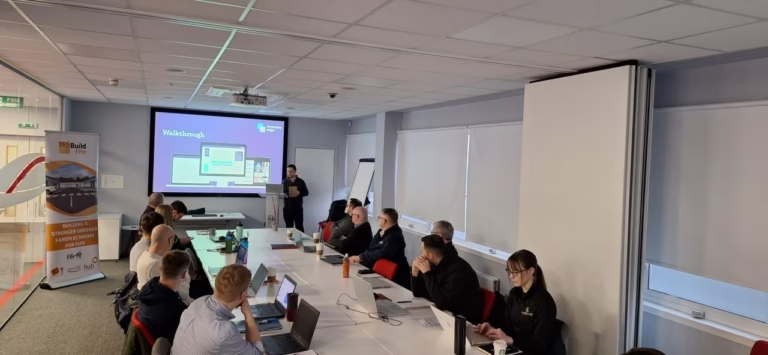
We’ve published a detailed account of what happens when a team meets its own behaviour in a simulation, so here is just the shape of it. In one recent session, a senior leadership team from a global services business opened by authorising twice the work it could deliver and drove the simulated company into insolvency by the second round. The same fourteen people closed the day with a jointly planned, profitable operation, having named their own pattern and its fix without being told either. The distance between the opening position and the close is the point: that journey, from expensive habit to corrected behaviour, is the one most change programmes budget a year for. The team travelled it before dinner, and what it carried out of the room was not a recommendation but a memory, and the fix it took home was one it had written itself.
The day is the catalyst; the weeks after are the change
A candid note, because it’s where simulation work is most often oversold: one day does not transform an organisation. What the day does is break the inertia that keeps transformation from starting. Teams leave with three assets that ordinary programmes struggle to produce at any speed: a shared, felt reference for what their habits cost; a vocabulary for naming the pattern the next time it appears in a real meeting; and the lived experience that changing the pattern pays. Every session is a turning point in exactly that sense: the team uncovers what has held it back and realises a new path forward together. The weeks after are where the new path gets walked, and the debrief is designed to transfer each simulation pattern onto its real-world twin so the follow-through has somewhere specific to land.
And that is the deeper reason simulations accelerate change: ownership changes sides. A change programme that arrives from above has to be sold to every team it touches. A change a team has discovered for itself has champions before the programme even starts. People rarely resist their own conclusions; they drive them. The simulation’s job is to make the change theirs. Their job, from that point on, is to lead it.
That’s also why a simulation slots into a change programme at almost any point. Before the programme, it works as a diagnostic that surfaces how the organisation actually behaves. At launch, it builds the felt case for change that no slide deck can. Mid-programme, it re-energises a stalled effort by letting people rehearse the target behaviours safely. If you’re weighing up the practicalities, our guide to business simulations for change management covers formats and how to choose, and ChangeManagement.Inc is the simulation we built specifically for this work.
Frequently asked questions
How do simulations accelerate organisational change?
By compressing the feedback loop that drives behaviour. In live operations, the consequences of how people work arrive months later; in a simulation they arrive in minutes, visibly and measurably. A team can experience its habits failing, diagnose why, and practise the alternative in a single day, which removes the slowest step in most change programmes: waiting for people to believe the case for change.
Is a simulation a replacement for a change management programme?
No, and it shouldn’t be sold as one. It’s a catalyst: it starts the reaction faster and at lower cost than months of persuasion, but the programme still does the sustaining work. The practical difference is that teams arrive at the programme already convinced by their own experience rather than needing to be convinced by it.
Where in a change programme does a simulation fit best?
Three places work well: before it, as a diagnostic of how teams actually behave under pressure; at launch, to build a felt case for change; or mid-programme, to unstick a stalled effort. The earlier it runs, the more of the programme benefits from the shared vocabulary it creates.
Do simulations work with change-resistant teams?
They’re at their best there, because resistance is usually a rational response to consequences the team can feel, and a simulation is the fastest honest way to change what the team feels. Nobody is asked to accept an argument; they’re invited to run a business, and the conclusions are their own. In our experience the most sceptical participants are frequently the ones the day moves furthest.
How long does the effect last?
The research on simulation-based learning shows stronger retention than conventional training (around 9% higher in the largest meta-analysis), but the honest driver of durability is the debrief and follow-through: mapping each pattern from the day onto its real-world twin, and reinforcing it in the weeks after. The day supplies the memory; the programme keeps it in use.
Immersive Edge runs one-day business simulations, used for diagnostics, training and change management, that let teams see themselves, their colleagues and the business with fresh clarity. If your change programme needs a catalyst, talk to us or see the case studies.