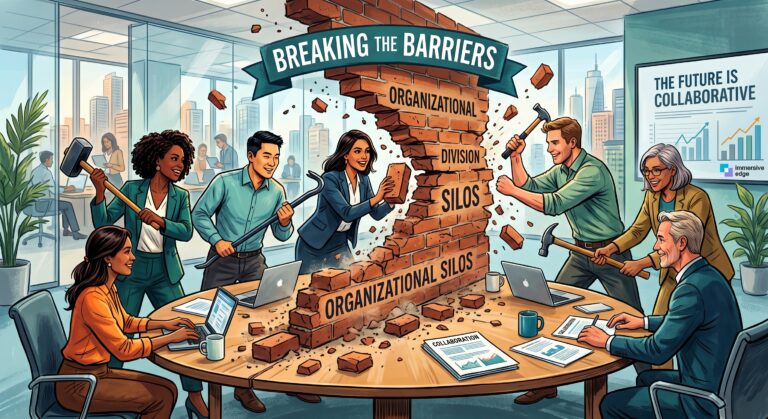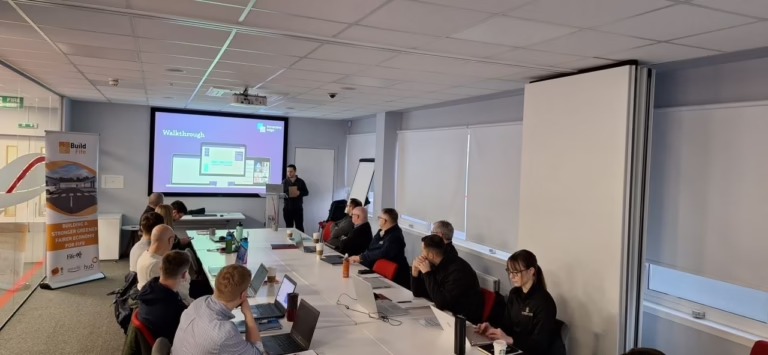
A change management simulation puts a team in charge of a realistic virtual business and lets it feel what change actually demands: decisions under pressure, consequences that arrive fast, and the need to work across functions to survive. Unlike conventional change training, nothing is explained in advance; teams discover how they respond to change by responding to it, in a safe environment where missteps become learning opportunities. This guide covers what a change management simulation does, the evidence for the approach, and how to choose one.
The real challenge of change management
The most quoted number in this field is that around 70% of change programmes fail. The figure is contested, and honest practitioners treat it as folklore rather than measurement, but nobody disputes the direction: most organisational change underdelivers, and the post-mortems rarely blame the strategy. They blame the human layer: behaviours that didn’t shift, middle managers who weren’t convinced, teams that complied in the workshop and reverted at their desks. We’ve examined this pattern in detail in why change programmes fail, and the short version is that change efforts fail where they were never really attempted: at the level of what people feel responsible for and respond to day to day.
Conventional change training struggles here for a structural reason. It explains the change, and explanation lands on the part of a person that already agreed. The part that resists, the habits shaped by years of real incentives and real consequences, never gets addressed, because training rooms don’t contain consequences.
What a change management simulation does differently
A simulation is a consequence machine. Participants take functional roles inside a struggling virtual business and run it through successive trading periods, compressed so that months of cause and effect play out in a day. Three properties do the work that explanation can’t.
Change stops being hypothetical. The simulated business puts the team through the exact experiences a real change programme produces: incomplete information, shifting priorities, pressure to deliver while the ground moves. Instead of discussing how they would respond to change, participants respond to it, and everyone in the room sees the response.
Consequences arrive while they can still teach. A poor hand-off, a hoarded piece of information, a decision taken without the downstream team: each shows up in the results within minutes, while the behaviour that caused it is fresh enough to connect. This is the loop change programmes wait months for, running several times before lunch.
Missteps are free. In live operations, nobody experiments during a change programme, because real money and real reputations are on the line, which is precisely when old habits grip hardest. In the simulation, mistakes cost nothing but teach everything, so people actually try the behaviours the change requires.
The evidence for the approach is well established: the largest meta-analysis of simulation-based training (Sitzmann, 2011, 65 studies, 6,000+ trainees) found simulation-trained participants ahead of conventionally taught comparison groups on self-efficacy (around 20% higher), procedural knowledge (14%) and retention (9%). For change work, self-efficacy is the headline: it’s the difference between a team that believes it can operate the new way and one that’s been told it should. And for the acceleration case, why one day moves teams that months of programme communication haven’t, see our companion piece on how business simulations accelerate change.
What it looks like in practice
The pattern we see across sessions is consistent enough to describe. Teams begin a simulation the way they begin real change: doing what they’ve always done, harder. Early rounds expose the existing behaviours, the local optimising, the missed handovers, the decisions made without the people downstream. Then the compressed consequences start to land, and somewhere in the middle of the day the conversation changes from defending the old pattern to redesigning it. By the closing round, the same people are running a visibly different operation, and in the debrief they map what changed in the room onto what needs to change at work. The case studies show how organisations have used that arc as the opening move of real change programmes.
For leadership teams specifically, the executive and boardroom simulation format applies the same mechanics at the level where change programmes are sponsored, which is where Lencioni and most change research agree the pattern is set.
Choosing the right change management simulation
Not all simulations are built for change work, and the selection criteria matter more than the brochure. Five things to look for:
Behavioural realism over technical realism. The simulation doesn’t need to model your industry precisely; it needs to reproduce the pressures that expose how your people actually behave: time, interdependence, incomplete information. Behaviour transfers; industry detail doesn’t need to.
Genuine cross-functional interdependence. If one strong individual can win the simulation alone, it will teach the opposite of what a change programme needs. The design should make collaboration the only route to a good result.
Felt consequence. Look for a running business with a P&L the whole team owns, so decisions land as shared outcomes rather than scores on individual dashboards.
A debrief that does the transfer. The day’s value is realised in the mapping between simulation patterns and your organisation’s real ones. Ask any provider how the debrief works and what participants leave holding; if the answer is a certificate, keep looking.
Measurement. Ask what the simulation instruments and reports. Behavioural observation plus platform metrics (utilisation, completion, results across rounds) turn the day from an experience into evidence you can put in front of a change board.
ChangeManagement.Inc is our simulation built specifically for this work, and it was designed against exactly those five criteria; sessions run in a day, in person or virtually, for teams from five people up.
Frequently asked questions
What is a change management simulation?
A facilitated experience in which a team runs a realistic virtual business through a period of pressure and change, compressed into a single day. It surfaces how the team actually responds to changing conditions, then uses a structured debrief to connect what happened in the room to the organisation’s real change effort.
How is it different from change management training?
Training explains change and hopes the explanation transfers; a simulation has the team experience change and draw its own conclusions. The research difference shows up in self-efficacy and retention: people leave a simulation believing they can work the new way because they just did, and that belief survives contact with the office far better than notes from a workshop.
Who should take part?
The teams whose behaviour the change depends on, which usually means more than the change team. Leadership teams benefit first, because the organisation copies its leaders; beyond that, any intact team living through the change, from operations to sales. Mixed cross-functional groups work especially well because the simulation’s interdependence mirrors their real hand-offs.
How do you measure whether it worked?
Three layers: what the platform measured on the day (performance across rounds, which shows the team’s capacity to adapt); what the debrief captured (the patterns the team named and the commitments it made); and what shows up in the weeks after, tracked against the change programme’s own metrics. A good provider gives you the first two in a written report so the third has a baseline.
Immersive Edge runs one-day business simulations, used for diagnostics, training and change management, that let teams see themselves, their colleagues and the business with fresh clarity. To talk through whether a simulation fits your change programme, contact us or book a demo.