
ChangeManagement.Inc
Successful systems implementation and organisational change adoption with simulation training.
Change management training
ChangeManagement.Inc recreates a fully operational business, then changes the way it has to work
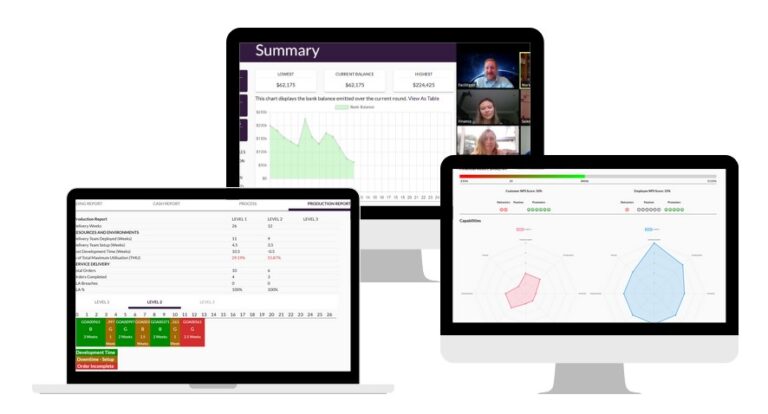
Split into departments and roles, teams have to turn a struggling business around by working together, while staying solvent and making a profit. Played in a room or entirely online, participants work out for themselves that a single, well run hub for data is the only way the business gets anywhere.
That is the whole mechanism. Nobody is told that the new system is a good idea. They arrive at it because the old way stops working in front of them.
We strongly believe that for people to accept a change, they must believe it was their idea all along. How better to do this than to let people experience a change in a safe simulated environment, understand the impact and what it means to them, and adapt to that change by modifying their own behaviour.
Benefits
What a group takes out of the day
Not a list of topics covered. These are the things people work out for themselves once they are running a business and the clock is going.
Business empathy
Silo thinking has consequences, and the group meets them. People learn to see a problem coming from another function before it lands on theirs.
Team collaboration
Teams work out quickly that the only way to win is together, which is exactly the thing a system rollout usually assumes and rarely gets.
Building trust
Trust between functions decides most of the result. People feel the cost of holding information back rather than being told about it.
The case for one system
Teams end up wanting a single view of the business, because they have just spent three rounds losing money without one.
Common goals
Teams build the strategy the business needs, then watch it survive contact with the next round, or not.
Learning outcomes
Change adopted rather than announced
Two groups bring us this simulation, and they want different things from it. We set the day up accordingly.
If you are rolling out a change
- Longer lasting change, because participants own it rather than comply with it
- A clearer understanding across the business of why preparation and change management matter
- New technology accepted from the ground up rather than imposed from the top
- A happier and more engaged workforce on the other side of the rollout
- Better programme success, and earlier warning when something is not landing
If you sell or implement one
- A shorter sales cycle, because decisions get made earlier
- More revenue opportunity from genuine engagement with senior stakeholders
- Wider and earlier expansion of programmes of work
- Higher licence take up, because people actually want to use the thing
- Happier clients, which is the part that brings the next engagement
Change management process
Most change management breaks down at the same point
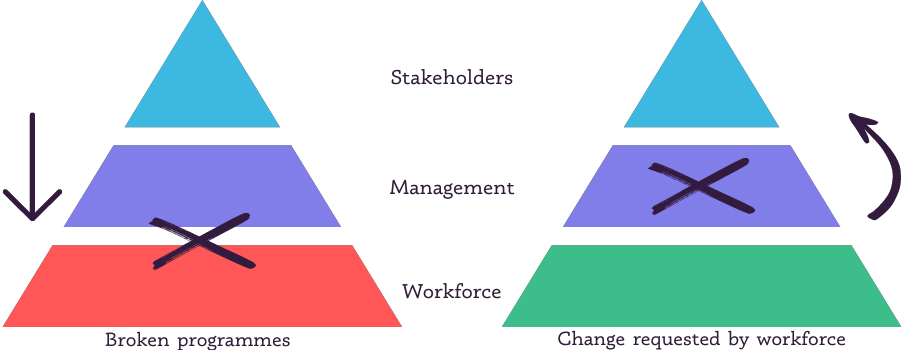
Users are asked to work a new way without context and without a reason they find convincing. Everything after that is an argument about compliance rather than a conversation about the business.
A simulation changes the order of that conversation. People meet the problem before they meet the solution, so the commitment is established before anyone asks for it.
Source: Tech Pro Research
Experiential learning: practice makes perfect
Experiential learning is the most effective way to change how an organisation thinks, sharpen judgement and create connections that hold. Recreating real business scenarios lets people learn by doing, and the engagement and emotional involvement that come with that are the reason it sticks.
It is also why a team still refers back to what happened in round two long after the rollout has moved on.
26 weeks in 26 minutes
We challenge teams to find the strategy that delivers organisational success, in a few short hours.
The simulations are designed for groups of 5 to 15 people and divided into three to four rounds. Each round is 26 minutes and covers the equivalent of 26 weeks of trade. After each round, teams reflect and learn from what went wrong so the next one goes better.
How it runs
Three ways to engage
Most clients start with us in the room and change that once they know what they are looking at.
We run it for you
We facilitate the day and work with your people beforehand to understand what you are trying to find out.
You get the session and our reading of what happened in it.
Best for
Team diagnostics, leadership away days, pilots before a wider rollout
A partner runs it with you
Several organisational development and leadership consultancies deliver our simulations inside their own programmes.
If the day is one step in something longer, a partner can build it into the programme and carry the work on afterwards. We will suggest one who fits.
Best for
Leadership programmes, change initiatives, blended development
Your own people run it
Once you have seen a day run and want it across the organisation, we train your facilitators over two days.
You get the simulation and the capability to run it. What you do not get is us in the room, so the debrief becomes yours to make.
Best for
Organisation‑wide rollout, repeat cohorts, in‑house academies
CONTACT US
Ready to implement organisational change?
Start changing now. ChangeManagement.Inc will transform your organisation.