

What your leadership team does when the pressure is real

Most leadership teams agree in the room. The trouble starts afterwards.

Picture of two business people shaking hands to represent the c-suite training and c-suite assessment simulation site.

Executive training simulations

Boardroom.Inc hands your team a business that is not working, and gives them an afternoon to fix it

Most leadership teams agree in the room. The trouble starts afterwards, when the agreement turns out to have meant something slightly different to each person who nodded at it, and the work goes out into the organisation in functional pieces.

You cannot see that happening in a meeting, because a meeting is the thing that hides it. You can see it in a day where the team has to run a business together, at speed, with real consequences and no way to defer a decision to next quarter.

The clock is the point. Under time pressure people stop performing the version of themselves they would present in a workshop and fall back on their defaults. Who consults and who does not. Which function gets listened to. Where the information stops moving. How much risk the team will carry when the quarter is going badly, which is not the number in the policy.

The results move in front of them as they decide, so the team is not waiting for a verdict at the end. They watch the consequence arrive while they can still do something about it.
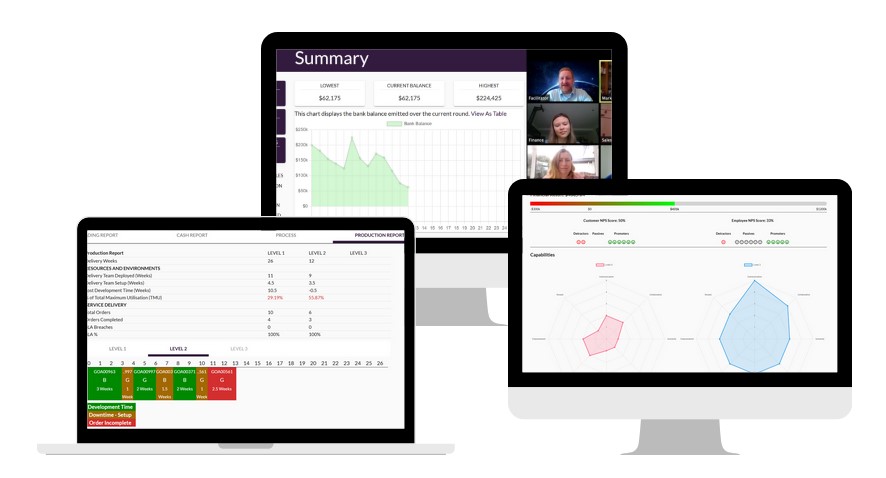
The Boardroom.Inc simulation dashboard, showing results as teams decide

You have probably already tried three things

None of them is a bad instrument. They just answer a different question from the one you have.

01

An away day

It asks people to discuss how they work. The discussion is honest and the conclusions are sensible, and nothing in it required anyone to actually do the thing under conditions where their defaults show.

02

An engagement survey

It tells you what people are willing to write down. That is a useful instrument for finding out what is already sayable, and a poor one for anything else.

03

Individual leadership assessment

It tells you about one person at a time, out of context. Teams do not fail one person at a time.

A simulation is the only one of the four that shows you the team deciding together, under pressure, while you watch.

What you take away

Our read of what happened, and something less formal that usually matters more: everyone in the room now shares a reference. "That is what we did in round two" turns out to be a faster way into a difficult conversation six months later than any framework will be.

In the write-up

  • How the team decided, and who was actually deciding
  • Where information stopped moving between functions
  • Which behaviours showed up once the clock was running
  • Where the team's appetite for risk actually sits, as against where the policy says it sits
  • What individuals did that they would not have predicted of themselves

Who has done this

  • 102 engagements for 44 organisations since 2021
  • Three in five came from a client who had already had us in once
  • An airline Leadership Institute: 70 leaders across seven cohorts
  • Three consultancies resell us, and have returned every year since they started
  • CPD accredited. Named clients and named people, on the record

What we do not give you is a measured business outcome. We do not have that data and we are not going to imply we do. If measuring it matters to you, say so before we start and we will design the day so that something is measurable, agreed in advance.

People change when they see themselves, not when they are told

The most useful thing in the debrief is usually not something we say. It is somebody recognising their own behaviour in what just happened, without anyone having to point it out.

That matters because an instruction to change has to survive the person's own judgement about whether it applies to them. A thing they saw themselves do does not have that problem. Some people need nothing more. Others need the day to sit inside a longer piece of work, which is a real answer and we will say so.

26 weeks in 26 minutes

The simulations are designed for groups of 5 to 15 people and divided into three to four rounds. Each round is 26 minutes and involves the equivalent of 26 weeks of trade. After each round, teams reflect and learn from past mistakes to improve their performance in the next one.

Twenty six minutes is one round. Watch the clock for a moment and you have the idea.

How it runs

Three ways to engage

Most clients start with us in the room and change that once they know what they are looking at.

We run it for you

We facilitate the day and work with your people beforehand to understand what you are trying to find out.

You get the session and our reading of what happened in it.

Best for

Team diagnostics, leadership away days, pilots before a wider rollout

Talk to us

A partner runs it with you

Several organisational development and leadership consultancies deliver our simulations inside their own programmes.

If the day is one step in something longer, a partner can build it into the programme and carry the work on afterwards. We will suggest one who fits.

Best for

Leadership programmes, change initiatives, blended development

Ask who we would suggest

Your own people run it

Once you have seen a day run and want it across the organisation, we train your facilitators over two days.

You get the simulation and the capability to run it. What you do not get is us in the room, so the debrief becomes yours to make.

Best for

Organisation‑wide rollout, repeat cohorts, in‑house academies

Ask about facilitator training

CONTACT US

Start at the top, then decide about everyone else

The usual way to buy this is to approve it for other people. It works better the other way round. One day with your own leadership team, two facilitators, and then you decide whether the rest of the organisation should do it, having been through it yourself.

Not ready for that? Ask for a walkthrough. One hour, where we show you the simulation so you can see what your team would be doing.