
Banking and financial services simulations
Understanding the banking operating environment and anticipating changes.

Simulations for banking and financial services
Financial services firms are facing many challenges when it comes to rapid technological changes and ever-changing regulations
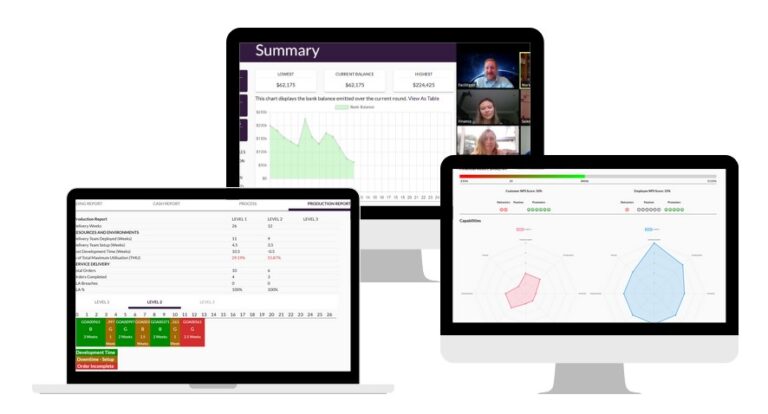
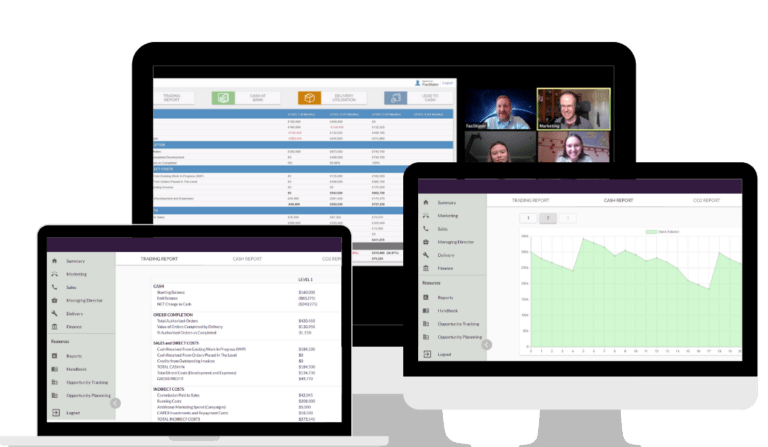
Our banking simulation recreates businesses using game technology and experiential learning methods. The simulation presents real-world business scenarios to develop problem-solving abilities.
Played virtually or in a classroom, participants learn to communicate and improve business skills by running a business in a realistic and interactive platform.
All Immersive Edge simulations are built on our award-winning ROCKET platform, a powerful, cost-effective and highly scalable platform with a realistic and interactive interface.
Benefits

Business empathy
Silo thinking has consequences. Learn how to anticipate problems before they happen.

Team collaboration
Teams rapidly realize that the only way they can win is through working together.

Building trust
Inter-departmental trust is critical. Teams learn to work in complete harmony.

Systems thinking
Enable 360 degree thinking, with teams thinking about the whole organization.

Common goals
Teams learn for themselves how to develop the strategy needed to create
a successful organization.
Learning outcomes
Our simulation games allow organizations to drive transformation in highly regulated financial environments.
- Breaking silos by experiencing the tensions that can emerge between roles, recognizing the importance of inter-departmental working to succeed.
- Keeping up with changing regulations by running a virtual business influenced by daily news and events.
- Dealing with changing technology and upgrading technology to ensure fitness for purpose.
- Familiarizing customer-facing roles to fast-moving and ever-changing environments.
- Building stronger teams by boosting confidence and teaching the importance of communication, processes, and systems in a business.
- Teaching business empathy by experiencing the typical roles of a business and how they inter-relate to create profit.
- Improving digital marketing strategies and new product ideas by allowing teams to work together and think outside of the box.
- Experiencing changing business models and staying ahead of increasing competition.
- Improving stress management skills to deal with fears and anxieties.
How it works:
Experiential learning
Practice makes perfect.
Experiential learning is the most successful method of driving organizational change, improving thinking skills and creating lasting connections.
The recreation of real-world business scenarios allows users to learn by doing and results in a higher player engagement and emotional involvement.
26 weeks in 26 minutes
We challenge teams to develop the strategies to deliver organizational success in only a few short hours
The simulations are designed for groups of 5 to 15 people and divided into three to four rounds. Each round is 26 minutes and involves the equivalent of 26 weeks of trade. After each round, teams get to reflect and learn from past mistakes to improve their performance in future rounds.
How it runs
Three ways to engage
Most clients start with us in the room and change that once they know what they are looking at.
We run it for you
We facilitate the day and work with your people beforehand to understand what you are trying to find out.
You get the session and our reading of what happened in it.
Best for
Team diagnostics, leadership away days, pilots before a wider rollout
A partner runs it with you
Several organisational development and leadership consultancies deliver our simulations inside their own programmes.
If the day is one step in something longer, a partner can build it into the programme and carry the work on afterwards. We will suggest one who fits.
Best for
Leadership programmes, change initiatives, blended development
Your own people run it
Once you have seen a day run and want it across the organisation, we train your facilitators over two days.
You get the simulation and the capability to run it. What you do not get is us in the room, so the debrief becomes yours to make.
Best for
Organisation‑wide rollout, repeat cohorts, in‑house academies